

Updated November 2026
If you’re buying, selling or listing a condo in 2027, the building’s budget is about to matter more than ever.
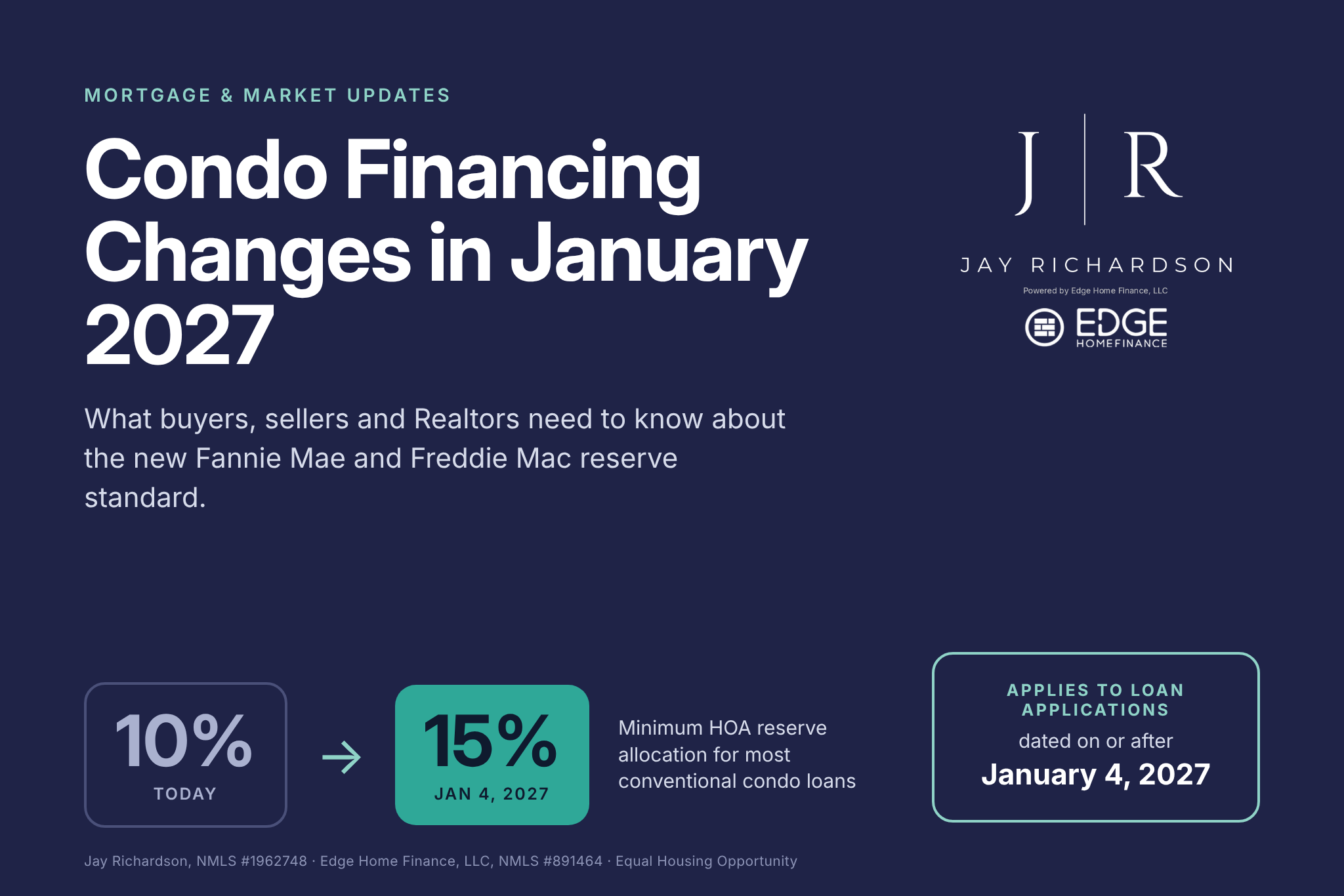
Beginning January 4, 2027, Fannie Mae and Freddie Mac are raising the minimum amount condo associations must set aside for future repairs. For many buildings, the requirement jumps from 10% of the annual budget to 15%.
That may sound like a back-office accounting detail. It isn’t. When a condo project doesn’t meet Fannie Mae and Freddie Mac standards, buyers in that building can lose access to most conventional financing. That can affect who can buy, how long a sale takes and, in some cases, what a unit is worth.
Here’s what’s changing, who it affects and what you can do about it now.
At a Glance
| Change | Effective | What it means |
|---|---|---|
| Limited Review and Streamlined Review retired | August 3, 2026 | Most condo loans now need a Full Review or a Waiver of Project Review |
| Reserve studies must be funded at the highest recommended level | August 3, 2026 | Baseline funding plans no longer qualify |
| Waiver of Project Review expanded | August 3, 2026 | Projects with 10 or fewer units may qualify |
| Annual insurance verification by servicers | January 1, 2027 | A servicing requirement, not a purchase eligibility change |
| Minimum reserve allocation rises from 10% to 15% | January 4, 2027 | Applies to Full Reviews for loan applications dated on or after this date |
1. What’s Changing on January 4, 2027?
When a buyer uses a conventional loan to purchase a condo, the lender doesn’t just review the buyer. In most cases, the lender also reviews the condo project itself, including its budget, reserves, insurance and overall financial health.
One key test is how much of the association’s annual budget goes into replacement reserves, the savings account that pays for big-ticket items like roofs, siding, elevators, decks and paving.
Today, the minimum is 10% of the association’s annual budgeted assessment income. (Lenders follow Fannie Mae and Freddie Mac rules on exactly how that figure is calculated, so your lender’s number may differ slightly from a simple budget percentage.)
Starting January 4, 2027, that minimum rises to 15% for projects reviewed under Fannie Mae and Freddie Mac’s Full Review process.
A simple example: An association with a $300,000 annual budget needs to budget at least $30,000 a year for reserves today. Under the new standard, that number becomes $45,000.
As a result, associations that come up short may need to raise dues, adjust their budgets or rely on a qualifying reserve study (more on that below).
2. The Loan Application Date Is What Counts
This is the most important practical detail for buyers.
The new 15% requirement applies to loan applications dated on or after January 4, 2027. Applications taken before that date are generally reviewed under the current 10% standard.
If you’re planning a condo purchase around the January 2027 transition, talk with your mortgage loan originator early. Which project-review requirements apply can depend on the loan application date, lender guidelines and the details of the transaction.
3. The Reserve Study Alternative
However, the 15% figure isn’t the only way for a building to qualify.
An association can instead rely on a professional reserve study, as long as the study was completed or updated within the last three years and the association’s budget funds reserves at the highest level the study recommends.
That last part matters, and it’s already in effect. For loan applications dated on or after August 3, 2026, associations can’t pick the lowest funding option in their reserve study and call it good. Baseline or minimum funding approaches no longer qualify.
For some well-managed buildings, a current reserve study may be a better path than the flat 15% test. For others, it may reveal that the association needs to fund even more.

4. This Builds on the Changes That Started in August
The January change is the second step in a larger update Fannie Mae and Freddie Mac announced in March 2026.
On August 3, 2026, both agencies retired their shortcut review options for established condo projects (Fannie Mae’s Limited Review and Freddie Mac’s Streamlined Review). Since then, most condo loans require either a Full Review of the project or a Waiver of Project Review. The stricter reserve study standard described above took effect on the same date.
A few changes in the update actually help condo buyers:
- Smaller projects get more flexibility. Projects with 10 or fewer units may qualify for a Waiver of Project Review, up from 4 or fewer units previously. In addition, projects with 5 to 10 units must not be part of a master association or larger development.
- The 50% investor-concentration limit is gone for established projects under Full Review. Buildings with a high share of rental units may have an easier path to conventional financing than they did before.
- Insurance rules are more flexible. Associations can now use actual cash value coverage for roofs in certain cases, and there’s more flexibility around master policy deductibles. That may help buildings dealing with rising premiums, though owners may want to review their own unit coverage to make sure they’re protected if the association’s deductible is higher.
On the other hand, more transactions now go through a detailed project review, and the reserve bar is about to go up.
5. What About Condos in Washington State?
Washington already requires most condominium associations to have a reserve study, generally updated each year, with a site visit by a reserve study professional every few years, unless doing so would impose an unreasonable hardship on the association.
Because of this, many Whatcom County and Snohomish County associations already have a head start.
But having a reserve study isn’t the same as following it. Washington law requires the study. Fannie Mae and Freddie Mac look at whether the association is actually funding reserves at the highest level the study recommends. Some associations will meet that standard. Others won’t.
The baseline funding wrinkle
Reserve studies prepared under Washington’s condominium statutes generally include two funding plans: a full funding plan and a baseline funding plan, which aims only to keep the reserve balance above zero. Boards trying to hold dues down have often budgeted to the baseline number. That’s still allowed under state law, but it no longer works for conventional financing when the association is relying on its reserve study.
Nevertheless, an association funding at the baseline level isn’t automatically out. It can still qualify if its budget meets the 15% test on its own. But a building that does neither may have trouble.
A quick example: A 40-unit association with $400,000 in annual assessment income that budgets $40,000 for reserves (10%) would need $60,000 to reach 15%. Spread evenly, that’s about $42 more per unit, per month.
The only way to know for sure is to look at the specific building’s budget and reserve study.
Not sure whether a specific building will qualify for conventional financing?
6. What Happens if a Condo Doesn’t Qualify?
When a project doesn’t meet Fannie Mae and Freddie Mac standards, it’s commonly called “non-warrantable.” That means a conventional loan on a unit in that building can’t be sold to Fannie Mae or Freddie Mac.
Non-warrantable doesn’t mean unfinanceable. Depending on the building and the buyer, other options may include portfolio loans and non-QM loans. These programs often come with different down payment requirements, rates and terms than conventional financing.
Meanwhile, FHA and VA loans use their own separate condo approval processes. The January change applies specifically to conventional loans sold to Fannie Mae and Freddie Mac.
7. What This Means for Condo Buyers
- Ask your lender early whether the building is likely to meet conventional guidelines. Don’t wait for underwriting to find out.
- If you’re shopping around the January transition, talk with your mortgage loan originator early about how the timing could affect the building you’re considering.
- Build extra time into your financing contingency. A project review takes longer than a buyer-only review.
- Look at the HOA dues closely. Some associations may raise dues in 2027 to meet the new standard, and higher dues affect your monthly payment and how much you qualify for.
- Ask about special assessments. An association catching up on underfunded reserves may consider one.
8. What This Means for Sellers and Current Owners
If you own a condo, these changes can affect you even if you aren’t selling.
Your association’s 2027 budget may include a dues increase to reach the 15% level or to fund its reserve study at the recommended level. That can feel frustrating, but a building that qualifies for conventional financing generally has a larger pool of potential buyers than one that doesn’t.
If you’re planning to sell in 2027, find out now where your building stands. Ask your board or management company for the current budget, the reserve contribution and the date of the most recent reserve study. Knowing this before you list can help prevent a deal from falling apart later.
Starting January 1, 2027, loan servicers are also expected to verify insurance coverage on condo projects each year. This is a servicing requirement, not a change to purchase eligibility, but owners may see more communication about insurance going forward.

9. Five Things Realtors Should Do Now
1. Pull the HOA budget early
Before writing an offer or taking a listing, check the annual reserve contribution as a percentage of the budget. Under 15% is a flag worth discussing with the buyer’s lender.
2. Ask for the reserve study
Note when it was completed and whether the association is funding at the highest recommended level.
3. Talk timing with buyers
For transactions around January 4, 2027, connect buyers with their lender early. Which standard applies depends on the loan application date.
4. Know the small-project waiver
Buildings with 10 or fewer units may qualify for a Waiver of Project Review, which can simplify the process.
5. Have a backup plan
If a building may not qualify for conventional financing, talk with a lender about portfolio and non-QM options before the buyer is under contract.
FREE CONDO FINANCING CHECKLIST
Put this guide into action with the free one-page checklist. Run the 15% test, spot the red flags and check the building before you write a condo offer.
The Bottom Line: Check the Numbers Early
The January 4, 2027 reserve change is designed to protect buyers and lenders from underfunded buildings and the surprise special assessments that often follow. Over time, that’s a good thing for condo owners.
In the short term, it raises the bar. Some buildings will adjust easily. Others will need to raise dues, update their reserve studies or accept that conventional financing may be harder to get.
The buyers, sellers and agents who check the numbers early will be in the best position.
Have a Condo Purchase or Sale Coming Up?
Whether you’re buying your first condo, selling a unit or representing a client, I’m happy to look at a specific building’s situation and talk through financing options.
I work with buyers and real estate professionals throughout Whatcom County, Snohomish County and surrounding Washington communities.
LET’S LOOK AT YOUR BUILDING
Together, we’ll review the building’s budget, your down payment and your estimated monthly payment with HOA dues to find an approach that fits your goals.
Jay Richardson
Mortgage Loan Originator, NMLS #1962748
Edge Home Finance, LLC, NMLS #891464
Equal Housing Opportunity
This article provides general educational information. Condo project eligibility, reserve requirements and underwriting guidelines vary by loan program, lender and transaction. Program requirements are subject to change.
Sources & References
- Fannie Mae: Lender Letter LL-2026-03, Updates to Project Standards and Property Insurance Requirements (March 18, 2026)
- Freddie Mac: Single-Family Seller/Servicer Guide Bulletin 2026-C (March 18, 2026)
- National Association of Realtors: Changes in Condominium Underwriting Guidelines
- National Mortgage Professional: January’s Condo Reserve Increase Puts Project Budgets in Focus
- Washington State Legislature: RCW 64.90.550, Reserve Study Contents
- Washington State Legislature: Chapter 64.90 RCW (Washington Uniform Common Interest Ownership Act)
Leave a Reply